United States · Breakfast · Easy
Buttermilk pancakes
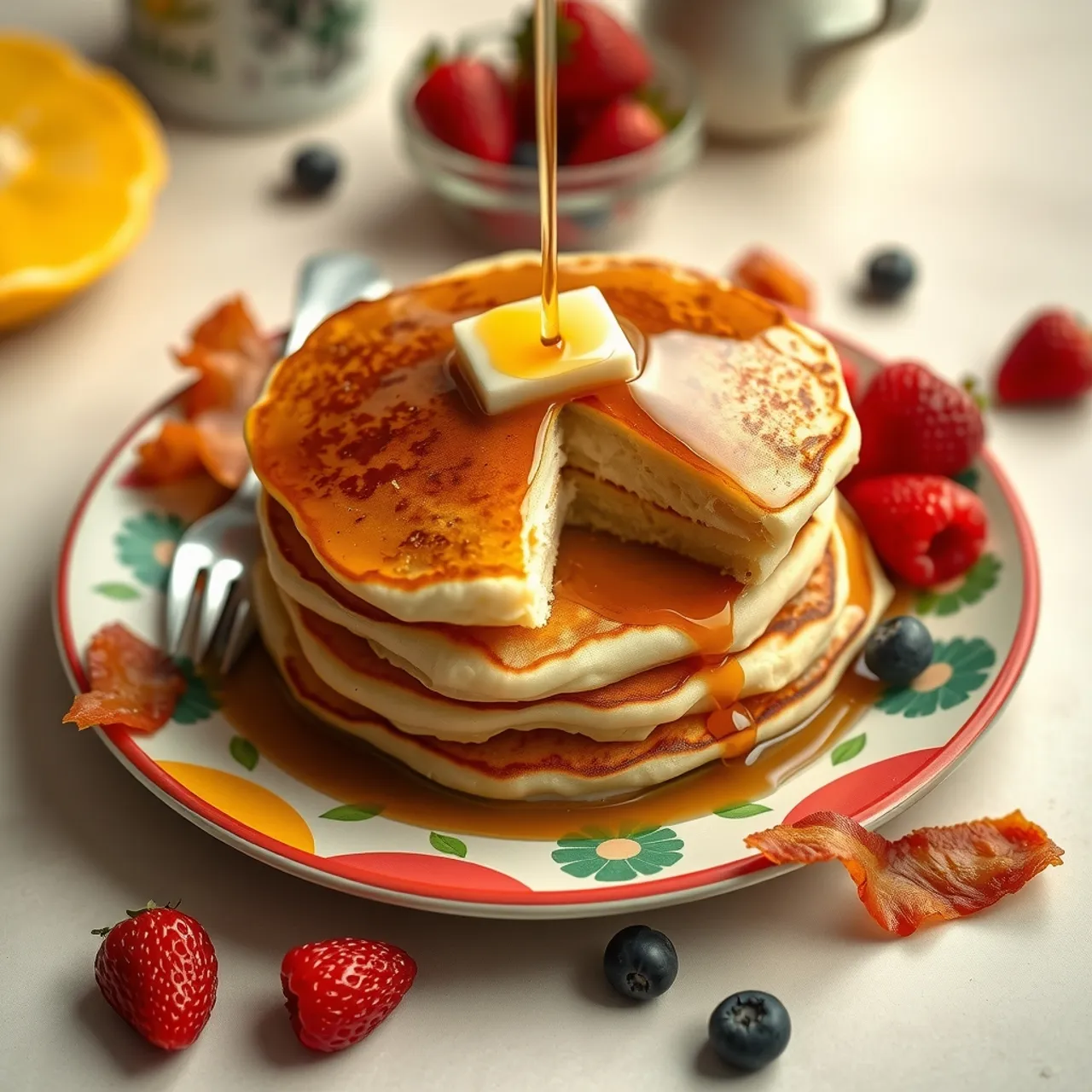
Tall, fluffy American griddle pancakes with maple syrup
Thick American breakfast pancakes made with buttermilk, baking powder and baking soda, cooked on a buttered griddle. The acid in the buttermilk reacts with the soda for a quick rise, and a barely mixed, rested batter keeps them tender and tall.
- Energy
- 504 kcalper serving
- Prep
- 10 min
- Cook
- 25 min
- Rest
- 10 min
- Protein
- 14 g
How was it?
Equipment
- Two mixing bowls
- Balloon whisk and a silicone spatula
- Cast-iron griddle or large heavy non-stick frying pan (28 cm)
- Thin metal or silicone turner
- 1/4-cup (60 ml) measure or small ladle
- Baking tray with a wire rack, for keeping warm
Before you start
- Take the buttermilk and eggs out of the fridge 30 minutes ahead; cold buttermilk makes the melted butter clump.
- Melt the butter for the batter and let it cool for 5 minutes.
- Heat the oven to 90 °C and set a wire rack on a baking tray inside.
- Warm the maple syrup in a small jug in a pan of hot water.
Method
-
Whisk the dry ingredients
250 g plain flour25 g caster sugar2 tsp baking powder½ tsp bicarbonate of soda¼ tsp fine saltIn the large bowl, whisk the flour, sugar, baking powder, bicarbonate of soda and salt together for 30 seconds.
Done when The mixture looks uniform with no white specks or lumps of soda.
Tip Press any lumps of bicarbonate through a sieve; a lump left in the batter tastes bitter and soapy.
-
Whisk the wet ingredients
480 ml buttermilk2 eggs45 g unsalted butter, meltedIn the second bowl, whisk the eggs until smooth, then whisk in the buttermilk. Drizzle in the cooled melted butter while whisking.
Done when The liquid is pale and even, with only tiny flecks of butter on the surface.
-
Combine briefly
Pour the wet mixture into the dry and fold with the spatula, 10–15 strokes, just until no dry flour is visible.
Done when The batter is thick and lumpy, with small pockets of flour-coated lumps; it falls from the spatula in slow ribbons.
Tip Stop while it still looks lumpy. Smooth batter means developed gluten and flat, rubbery pancakes.
-
Rest the batter
Leave the batter to stand at room temperature for 10 minutes. Do not stir it again.
Done when Bubbles appear on the surface and the batter looks puffier and thicker than when it was mixed.
-
Heat the griddle
Heat the griddle over medium heat for 4–5 minutes, to about 190 °C on the surface.
Done when A few drops of water flicked on the surface dance and evaporate in 2–3 seconds instead of sitting still or vanishing instantly.
190 °C · 374 °F -
Grease and test
10 g unsalted butter, for the griddleWipe a thin film of butter over the griddle with folded kitchen paper. Cook one small test pancake to check the heat.
Done when The butter foams gently without browning, and the test pancake is evenly golden underneath after about 2 minutes.
Tip The first pancake is a thermometer. If it browns in under a minute, lower the heat; if it is pale after 3 minutes, raise it.
190 °C · 374 °F -
Pour and cook the first side
Pour 60 ml portions of batter onto the griddle, 5 cm apart, without spreading them. Cook for 2–3 minutes over medium heat, without touching.
Done when Bubbles rise and pop across the surface and stay open, and the edges look matt and set.
Tip Flip only when the bubbles near the centre stay open. Flipping early tears the pancake and leaks raw batter.
190 °C · 374 °F -
Flip once
Slide the turner under each pancake and flip it in one quick movement. Cook the second side for 1–2 minutes over medium heat. Do not press down.
Done when The pancake rises noticeably after flipping and springs back when pressed lightly in the centre; the underside is golden brown.
190 °C · 374 °F -
Keep warm
Transfer the pancakes to the rack in the 90 °C oven in a single layer. Re-grease the griddle and repeat with the rest of the batter.
Done when The pancakes stay soft and hot without drying at the edges.
Tip Do not stack them while you cook; steam trapped between them makes them gummy.
90 °C · 194 °F -
Serve
80 ml maple syrupStack 3 pancakes on each warm plate and pour the warm maple syrup over the top.
Done when The syrup soaks into the top pancake and runs down the sides of the stack.
Common mistakes
The pancakes are flat and tough.
Fix The batter was overmixed. Fold only until the dry flour disappears and leave the lumps.
Burnt outside, raw inside.
Fix The griddle was too hot. Cook at medium heat (about 190 °C) and use a test pancake to adjust.
They taste bitter or metallic.
Fix Too much leavening or a lump of soda. Measure level spoons and whisk the dry ingredients thoroughly first.
Pale, greasy, blotchy pancakes.
Fix Too much fat on the griddle. Wipe it to a thin film with kitchen paper between batches.
Serving
Serve hot, 3 per plate, with warm maple syrup and a pat of butter. Fresh berries or crisp bacon on the side are the usual American partners.
Storage and reheating
Cool completely, then keep in the fridge in a sealed container for up to 2 days, or freeze with baking paper between layers for up to 2 months. Reheat in a toaster or in a 180 °C oven for 5–8 minutes, from frozen 10 minutes.
Make ahead
Mix the dry ingredients up to 1 week ahead and keep them in a sealed jar. The batter itself loses its rise after about 1 hour, so mix it just before cooking.
Variations
Blueberry pancakes
Pour the batter, then scatter 6–8 blueberries over each pancake before flipping. Mixing the berries into the batter turns it purple.
Without buttermilk
Stir 2 tablespoons of lemon juice into 480 ml of whole milk and leave it 10 minutes until it thickens slightly. The pancakes are a little less tangy and rise slightly less.
Vegan
Use 480 ml of soy or oat milk soured with 2 tablespoons of lemon juice, replace the eggs with 2 tablespoons of ground flaxseed mixed with 6 tablespoons of water, and use melted coconut oil or vegan butter. They are slightly denser.