Brazil · Bread · Medium
Pão de queijo
Brazilian cheese bread: crisp outside, chewy and hollow-hearted inside
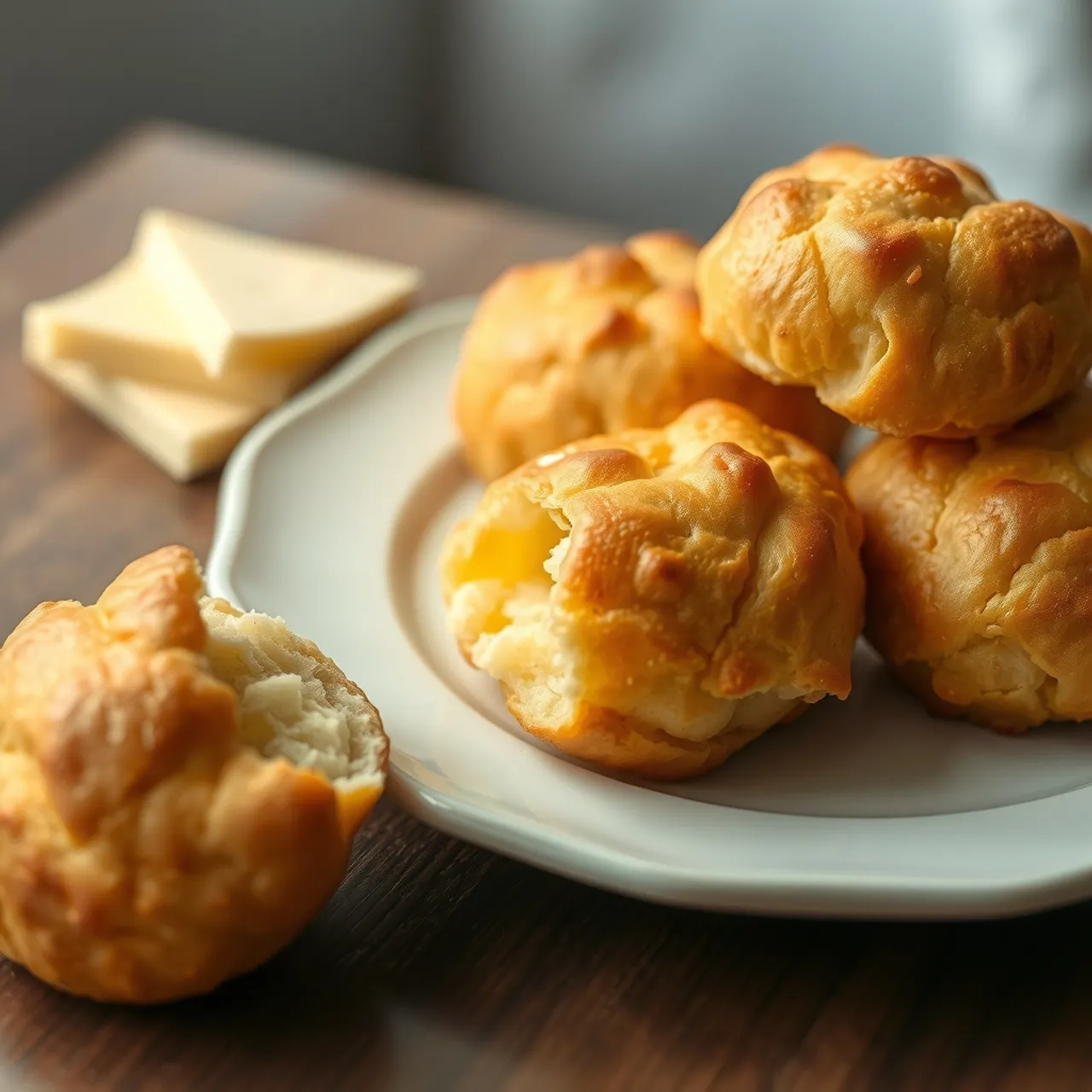
Small, puffy cheese breads from Minas Gerais made with tapioca starch, milk, oil, eggs and cured cheese, naturally free of gluten. Scalding the starch with boiling milk and oil gelatinises part of it, which gives the dough its stretch and the breads their springy, chewy centre.
- Energy
- 395 kcalper serving
- Prep
- 30 min
- Cook
- 30 min
- Rest
- 15 min
- Protein
- 8 g
How was it?
Equipment
- Large heatproof mixing bowl
- Small saucepan
- Wooden spoon or stand mixer with paddle
- 2 baking trays lined with baking paper
- Fine grater
Before you start
- Grate the cheese finely.
- Beat the eggs lightly in a jug.
- Line the baking trays and set the oven racks in the upper and lower thirds.
Method
-
Preheat the oven
Heat the oven to 190 °C (170 °C fan).
Done when The oven light has gone off and the oven has held its temperature for at least 10 minutes.
190 °C · 374 °F -
Combine the starches
250 g sour tapioca starch (polvilho azedo)250 g sweet tapioca starch (polvilho doce)Put both starches in the heatproof bowl and mix with your fingers, breaking up any lumps.
Done when The starch is evenly fine and powdery, and squeaks slightly between your fingers.
-
Boil the milk and oil
300 ml whole milk120 ml sunflower oil8 g fine saltPut the milk, oil and salt in the saucepan and bring to the boil over medium heat, 3–4 minutes.
Done when The milk froths up and starts to rise up the sides of the pan.
Tip Watch it closely: milk boils over within seconds.
-
Scald the starch
300 ml whole milk120 ml sunflower oil8 g fine salt250 g sour tapioca starch (polvilho azedo)250 g sweet tapioca starch (polvilho doce)Pour the boiling liquid over the starch all at once and stir hard with the wooden spoon until no dry powder remains.
Done when The mixture is lumpy, sticky and partly translucent, like wet crumbs that cling together.
Tip The liquid must be boiling. If it is only hot, the starch does not gelatinise and the breads stay flat and dense.
-
Cool the dough
Leave the dough to cool for 10–15 minutes, stirring once or twice.
Done when The dough feels warm but no longer hot when you hold your hand on it, around 40 °C.
-
Add the eggs
3 eggsAdd the eggs a little at a time, mixing or kneading well after each addition until absorbed.
Done when The dough first turns slippery and broken, then comes back together smooth and sticky.
Tip Eggs vary in size. Stop adding when the dough is soft but still holds a shape; it should not be runny.
-
Knead in the cheese
250 g queijo minas meia-curaAdd the cheese and knead with your hands or the paddle for 3–4 minutes.
Done when The dough is smooth, soft and slightly sticky, and holds a ball without slumping.
-
Shape the balls
120 ml sunflower oilOil your hands lightly and roll the dough into 3 cm balls (about 30 g each). Set them on the trays 4 cm apart.
Done when The balls are round and smooth on the surface with no cracks.
Tip If the dough sticks to your hands, re-oil them every few balls rather than adding starch.
-
Bake
Bake for 25–30 minutes, swapping the trays halfway through. Do not open the oven in the first 15 minutes.
Done when The breads have puffed to about one and a half times their size, are golden at the base and pale golden on top, and sound hollow when tapped.
190 °C · 374 °F -
Cool briefly and serve
Leave on the tray for 5 minutes, then serve warm.
Done when The crust is crisp and the inside is stretchy and steaming when you pull one open.
Common mistakes
The breads are flat and dense.
Fix The liquid was not boiling when poured, or the dough was too wet. Pour it at a full boil and add the last egg only if the dough needs it.
They spread and crack open.
Fix The dough was too soft or the oven too cool. Hold back some egg and make sure the oven is fully preheated.
They collapse after baking.
Fix Underbaked. Bake until they sound hollow and are golden on the base, and keep the oven closed for the first 15 minutes.
The flavour is bland.
Fix The cheese was too mild. Use a semi-aged, salty cheese such as meia-cura or parmesan, not fresh mozzarella alone.
Serving
Serve warm, straight from the oven, with coffee for breakfast or as a snack. Four breads make a serving; they are also good split and filled with ham or guava paste.
Storage and reheating
Best eaten the day they are baked. Keep baked breads in an airtight box for 1 day and refresh them at 180 °C for 5 minutes. Freeze baked breads up to 1 month.
Make ahead
Freeze the shaped raw balls on a tray, then bag them; they keep 3 months. Bake from frozen at 190 °C for 30–35 minutes, without thawing.
Variations
Only sweet starch
Use 500 g of polvilho doce if you cannot find polvilho azedo. The breads rise less and are softer and chewier.
Parmesan and mozzarella
Outside Brazil, use 150 g of finely grated parmesan and 100 g of grated low-moisture mozzarella. The breads are saltier and more savoury.
Blender batter (muffin tin)
Blend the starch, milk, oil, eggs, salt and cheese cold until smooth, pour into an oiled 24-hole mini muffin tin and bake at 200 °C for 20–25 minutes. Quicker, with a lighter, cake-like crumb.