Japan · Main · Medium
Oyakodon
Japanese chicken and egg simmered in dashi over rice
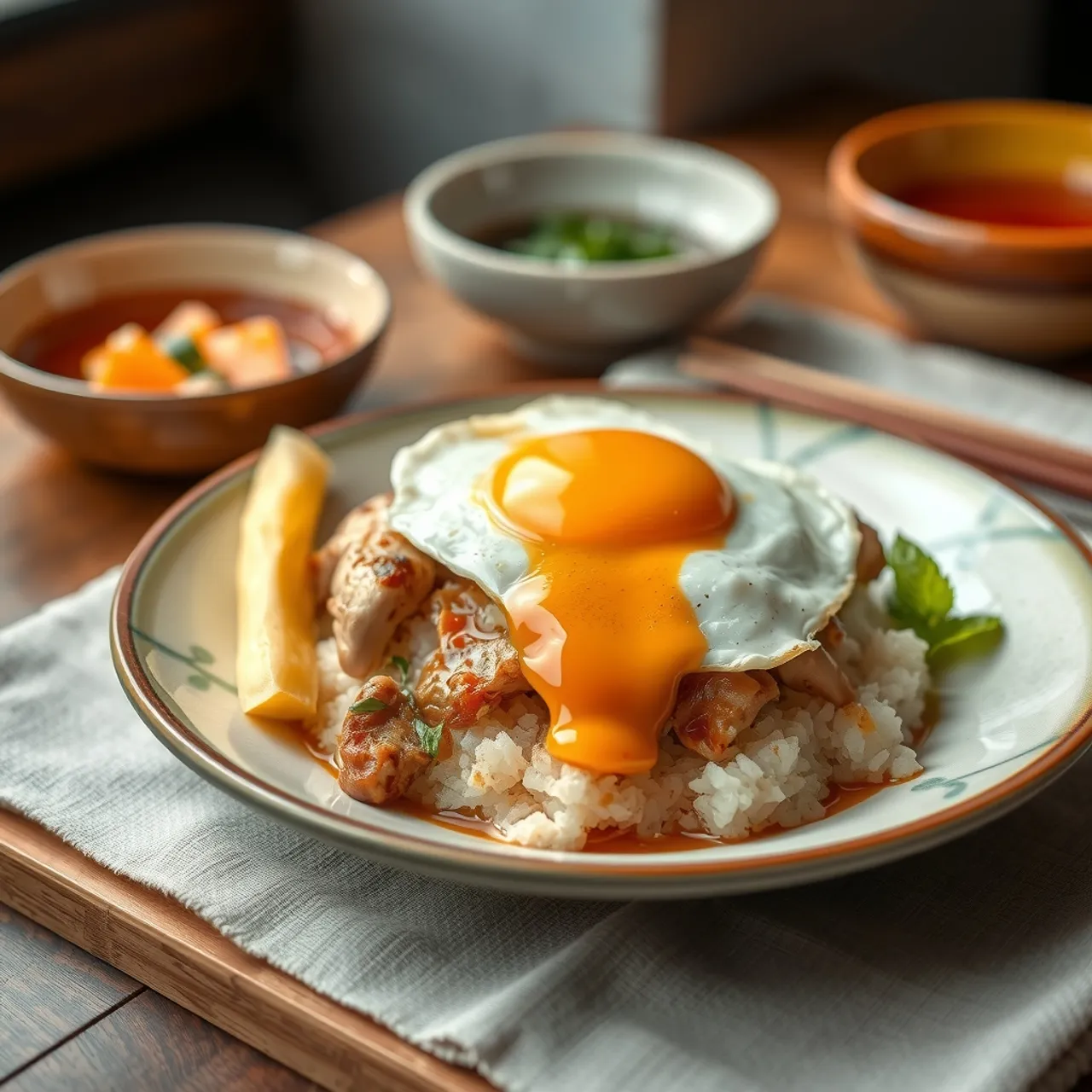
Chicken thigh and onion simmered in a sweet dashi, soy and mirin broth, then bound with softly set egg and slid over a bowl of hot rice. Cooking one bowl at a time in a small pan and adding the egg in two pours gives a custardy top over a just-set base.
- Energy
- 840 kcalper serving
- Prep
- 15 min
- Cook
- 30 min
- Protein
- 39 g
How was it?
Equipment
- Heavy saucepan (2 l) with a tight lid
- Small frying pan (18–20 cm) with a lid, or an oyakodon pan
- Small jug for the sauce
- 2 small bowls for the eggs
- Chopsticks
- 2 deep donburi bowls
- Instant-read thermometer
Before you start
- Rinse the rice in cold water 3–4 times until the water runs almost clear, soak it in fresh water for 30 minutes and drain well.
- Cut the chicken into 3 cm pieces, trimming any loose fat.
- Slice the onion and cut the mitsuba into 3 cm lengths.
- Crack 2 eggs into each of the two small bowls.
Method
-
Cook the rice
200 g Japanese short-grain rice240 ml waterPut the drained rice and the water in the saucepan and bring to a boil over high heat. Cover, turn the heat to low and cook for 13 minutes, then take it off the heat and leave it covered for 10 minutes.
Done when The water is fully absorbed, the surface has small steam holes and the grains are shiny and tender.
-
Mix the simmering sauce
180 ml dashi2 tbsp soy sauce2 tbsp mirin10 g sugarStir the dashi, soy sauce, mirin and sugar together in the jug until the sugar dissolves.
Done when The sauce is clear amber and no sugar grains sit on the bottom of the jug.
-
Simmer the onion
180 ml dashi2 tbsp soy sauce2 tbsp mirin10 g sugar120 g onionPour half of the sauce into the small frying pan, add half of the onion and bring to a simmer over medium heat. Simmer for 3 minutes.
Done when The onion has turned translucent and limp, and the sauce bubbles gently at the edges.
-
Poach the chicken
220 g boneless chicken thighs, skin onAdd half of the chicken, skin side up, in one layer. Simmer over medium heat for 5–6 minutes, turning the pieces once halfway, until they reach 74 °C in the centre.
Done when The chicken is opaque white all the way through with no pink when you cut the largest piece, and the sauce has reduced by about a third.
Tip Check the largest piece with a thermometer: 74 °C is the safe temperature for chicken.
-
Beat the eggs lightly
4 eggsBeat one bowl of eggs with chopsticks for only 3–4 strokes, just to break the yolks.
Done when Streaks of yellow and clear white are still visible; the egg is not uniform or frothy.
Tip Under-beating is deliberate. The streaks of white and yolk set at different speeds and give the soft, marbled texture.
-
First pour of egg
4 eggsRaise the heat to medium-high. Pour about two thirds of the beaten egg in a spiral over the chicken, cover and cook for 30–40 seconds.
Done when The egg around the edges and over the chicken has set and turned opaque, while the middle is still liquid.
-
Second pour of egg
4 eggs4 sprigs mitsubaPour in the rest of the egg, scatter half of the mitsuba on top, cover and cook for 15–20 seconds. Take the pan off the heat.
Done when The top layer is glossy and just starting to set, wobbling like soft custard when you shake the pan.
Tip For fully set eggs (recommended for children, pregnant women and older people), keep the lid on over low heat for 1 more minute.
-
Slide onto the rice
200 g Japanese short-grain riceFill a donburi bowl with half of the rice. Tilt the pan and slide the chicken and egg onto the rice in one piece, pouring over any sauce left in the pan.
Done when The topping covers the rice completely and the sauce soaks into the top layer of grains.
Tip Shake the pan back and forth just before sliding to loosen the egg from the bottom.
-
Cook the second bowl
180 ml dashi2 tbsp soy sauce2 tbsp mirin10 g sugar120 g onion220 g boneless chicken thighs, skin on4 eggs4 sprigs mitsuba200 g Japanese short-grain riceRinse the pan quickly and repeat the onion, chicken and egg steps with the remaining sauce, onion, chicken, eggs and mitsuba. Slide it onto the rest of the rice.
Done when The second bowl looks like the first: a glossy, softly set egg top with chicken and onion showing through.
-
Season and serve
to taste shichimi togarashiServe straight away, with shichimi togarashi at the table to sprinkle on top.
Done when Steam rises from the bowl and the egg still looks soft and moist.
Common mistakes
The egg sets hard and rubbery.
Fix Take the pan off the heat while the top is still loose: the egg keeps cooking from the heat of the rice. Add it in two pours, not one.
The bowl is too salty or too sweet.
Fix Keep the dashi, soy sauce and mirin ratio as written, and use less soy sauce if your dashi is instant.
The chicken is undercooked in the middle.
Fix Cut it into even 3 cm pieces and simmer until the largest piece reaches 74 °C before any egg goes in.
The topping breaks up when you move it to the bowl.
Fix Use a small pan so the topping is thick enough to hold together, and shake it loose before sliding it out.
Serving
Serve in deep bowls as soon as the egg is on the rice, with miso soup and Japanese pickles (tsukemono) on the side.
Storage and reheating
Best eaten immediately. Leftovers keep 1 day in the fridge, covered. Reheat in the microwave until piping hot all the way through; the egg will set firm.
Make ahead
The simmering sauce keeps 3 days in the fridge. The chicken and onion can be cut and kept covered in the fridge up to 1 day ahead. Cook the egg only just before eating.
Variations
Tanin-don
Use 220 g of thinly sliced pork shoulder or beef instead of the chicken and simmer for 2–3 minutes until no pink remains. The name means strangers' bowl, since the meat and egg are unrelated.
Skinless and lighter
Remove the skin from the chicken thighs before cutting. It saves about 90 kcal and 10 g of fat per bowl; simmer 1 minute less so the meat stays juicy.
Vegetarian
Use kombu and dried shiitake dashi, and replace the chicken with 200 g of deep-fried tofu (atsuage) cut into 2 cm cubes, simmered for 3 minutes before the egg goes in.